General
Founded in 1991, De Lijn provides bus and tram transport in Flanders, in northern Belgium. De Lijn also operates lines to Brussels, several Walloon municipalities and the Netherlands.
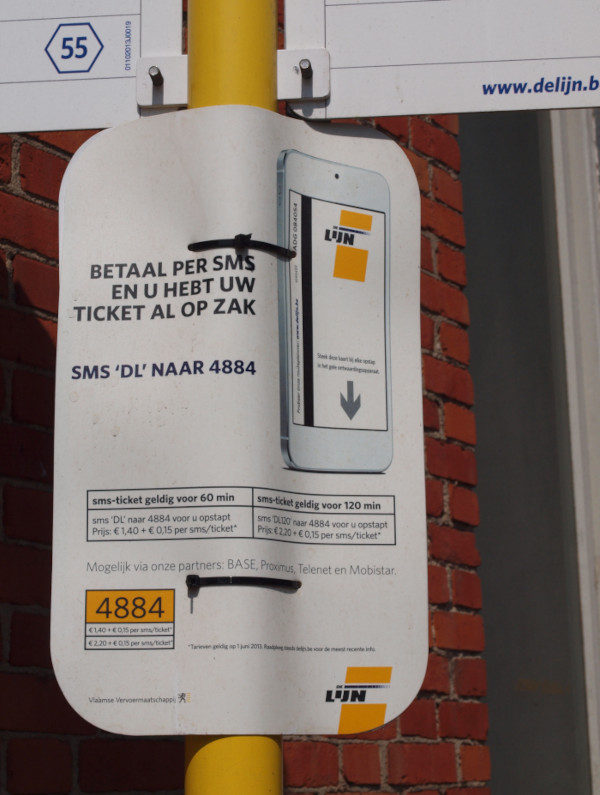
On 6 September 2007, De Lijn launched the option to purchase tickets via text message, the sms-ticket. Initially, this was only available to customers of one telephone provider (Proximus) and only for the cities of Antwerp and Ghent. On 1 February 2010, the system was expanded to cover the whole of Flanders for Proximus customers. This resulted in a threefold increase in the sale of text message tickets. In 2011, the use of this system was extended to all Belgian telephone providers.
The aim was to reduce ticket sales by drivers, which would enable buses and trams to run more punctually. Initially, text message tickets were also cheaper than tickets purchased from the driver.
In 2014, for the first time, more tickets were sold via text message than by the driver. By the end of 2015, 6 out of 10 tickets were text message tickets. Only 39% were still purchased from the driver.
Since september 2016 the sms-ticket is no longer the cheapest option for a 60 minute ticket. The m-ticket, introduced in that month, is now the cheaper option. The m-ticket is a digital ticket that can be bought via a third party app or via the De Lijn website.
Usage
It is quite simple to use. Before the journey begins, the traveller sends a code to the number 4884. The code determines what kind of ticket the traveller is buying. The traveller receives a confirmation via text message. That confirmation is the ticket. The confirmation can be checked by the staff during the journey, just like any other ticket.
The traveller pays for the journey on their monthly phone bill. In the case of a prepaid phone, the fare is deducted directly from the credit balance.
Only travellers with a Belgian phone provider can use the sms-ticket.
Tickets for multiple travellers can be purchased on one phone.
| code | type of ticket |
|---|---|
| DL | 60 minute ticket |
| DL# | same as DL, where # is the number of passengers with a maximum of 5 |
| DLA | 60 minute ticket, only valid in Antwerp |
| DLG | 60 minute ticket, only valid in Ghent |
| DL120 | 120 minute ticket |
| DLD | day ticket |
| SL K | 60 minute ticket for the student buses to Brussels |
| SL L | 150 minute ticket for the student buses to Brussels |
| SL S | 150 minute ticket for the student buses to Brussels, with a student discount |
| GENTSEFEESTEN | return ticket to and from Ghent during the Ghent Festival |
| SHOPGENT | free 60 minute ticket to and from Ghent during Sunday shopping |
| SHOPGENT# | same as SHOPGENT, where # is the number of passengers with a maximum of 5 |
Area of transport
Initially, the tickets could only be used in Antwerp and Ghent. Since 2011, the tickets can be used on almost all De Lijn bus and tram lines in Flanders.
Fares
In the early years, it was only possible to buy a ticket that was valid for 60 minutes. In 2010, the option of a 120-minute ticket was added. Five years later, this option was discontinued and the range was limited again to a 60-minute ticket. Since 2018, the range has been expanded to include a day ticket that is valid for 24 hours.
| date | 60 minutes | 120 minutes | 24 hours |
|---|---|---|---|
| 06-09-2007 | € 1.20 | x | x |
| 01-02-2010 | € 1.30 | € 2.10 | x |
| 01-02-2013 | € 1.40 | € 2.20 | x |
| 01-02-2015 | € 1.80 | x | x |
| 01-02-2017 | € 2.00 | x | x |
| 01-02-2018 | € 2.00 | x | € 6.00 |
| 01-02-2019 | € 2.10 | x | € 7.00 |
| 01-02-2020 | € 2.50 | x | € 7.50 |
| 01-04-2025 | € 3.00 | x | € 9.00 |
An extra fee, an operator charge, is addes to each sms-ticket. initially the operator charge was 0.15 euros. Since april 2025 the operator charge is 0.25 euros.
The range of tickets was temporarily expanded in 2022, 2023 and 2024 for the Ghent Festival ("Gentse Feesten"), which is held annually in July. This SMS ticket cost 5 euros and was valid for a return trip to and from Ghent.
Since May 2022 shoppers in Ghent can use a free 60 minute ticket during Sunday shopping. Although the ticket is free, the operator charge has to be paid. It is possible to buy this ticket for a maximum of 5 persons at a time. In that case the operator charge only has to be paid once.
There are also a number of tickets for the student lines 178 and 179 to Brussels that are valid for 60 or 150 minutes.
| date | 60 minutes | 150 minutes | 150 minutes, student discount |
|---|---|---|---|
| since 2025 | € 3.00 | € 9.00 | € 4.50 |
Research
| year | sold tickets | remarks |
|---|---|---|
| 2007 | 51,914 | only in Antwerp and Ghent, only for Proximus customers, since 6 September |
| 2008 | 201,144 | |
| 2009 | 260,671 | |
| 2010 | 857,298 | expanded to all of Flandres, only for Proximus customers |
| 2011 | 3,097,443 | expanded to all telephone providers in Belgium |
| 2012 | 5,564,933 | |
| 2013 | 8,052,557 | |
| 2014 | 9,859,405 | |
| 2015 | 11,200,000 |
As of 2016 De Lijn no longer publishes seperate sales numbers of sms-tickets. De Lijn now publishes the sales numbers of all digital tickets, thus sms-ticket and m-ticket, as one.
some other interesting facts
- Research from early 2010 showed that 86 percent of the users was satisfied with the new system
- According to De Lijn in 2011, punctuality had improved thanks to the sms-ticket. Ticket sales by drivers had fallen by more than 20%. De Lijn attributed this to the fact that sms-tickets were cheaper.
- In 2014, sms-tickets were purchased from 818,000 unique telephone numbers. This was an increase of 17 percent compared to the previous year.
- In 2015, it became evident that sms-tickets are particularly popular among young people. 65% of sms-tickets were purchased by travellers between the ages of 12 and 30.
- Most young people (aged 18-30) also purchased multiple tickets per month in 2015. 42% purchased 2 to 4 tickets per month and 15% purchased 5 to 9 tickets per month.